
Featured in Nikon Owner Magazine
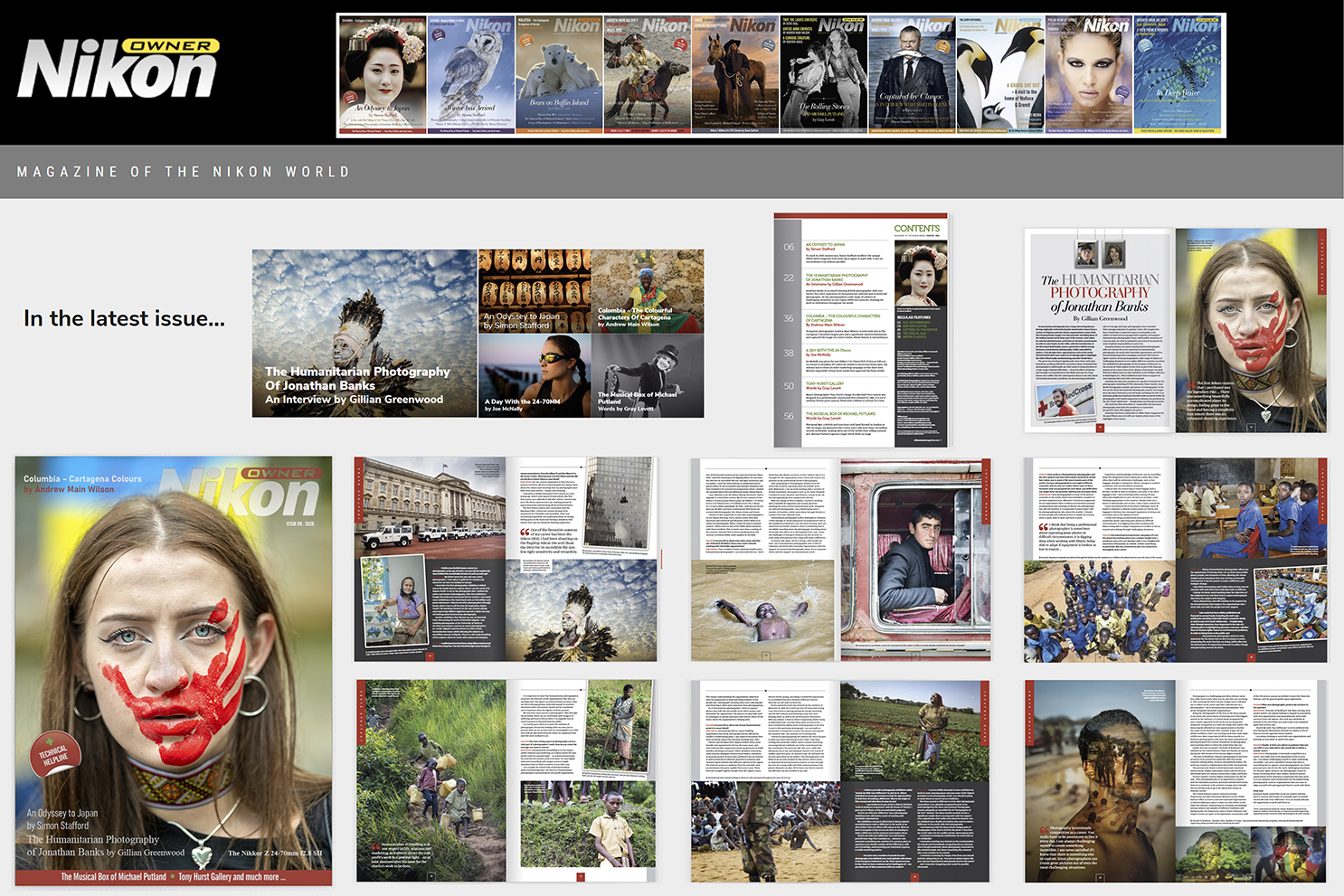
The current Nikon Owner Magazine (Issue 89) has a fourteen-page feature on my career as a humanitarian photographer. I was interviewed by Gillian Greenwood about my work, exploring my approach and aspirations. We discussed equipment, my inspirations, how I came to specialise in humanitarian photography, various assignments and my recent exhibitions.
“For me, camera equipment is there for us to express ourselves. My love of photography has always been about the subject and ensuring that my photographs have both form and content … beauty and meaning.”
“Humanitarian photography is often under paid or voluntary, I often damage or break equipment on assignments due to the conditions of wherever I am, the hours are long, and I am away from my family. However, there is something that is incredibly rewarding about the photography, humbling about the people who allow me to photograph them, and I enjoy the challenges of having to think on my feet to come away with pictures that I hope will make a difference.”
Nikon Owner has been the authoritative photographic publication for over twenty years. With its mix of stunning images and inspirational articles from many of the world’s leading Nikon professionals, as well as the very latest reviews on Nikon equipment, Nikon Owner provides a bridge between theory and practical, technical knowledge and accomplishment. The magazine is edited by Gray Levett of Grays of Westminster, the multi-award-winning Nikon store in London.
You can read the full transcript from the interview below or on the Nikon Owner Magazine website at – www.nikonownermagazine.com/subscribers/online-magazine/issue-089/34/
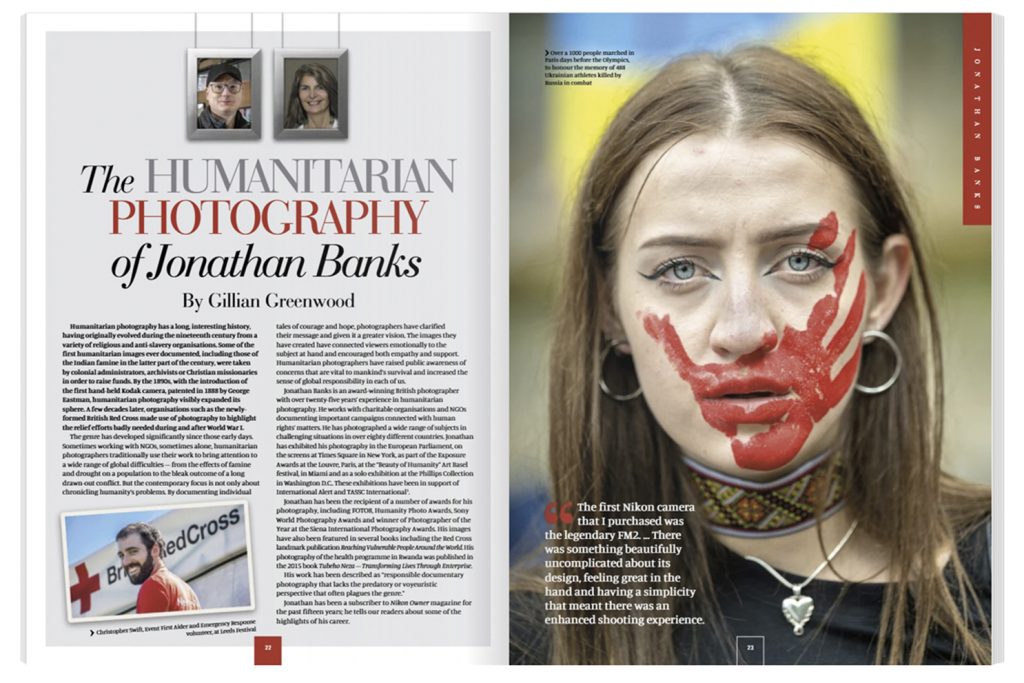
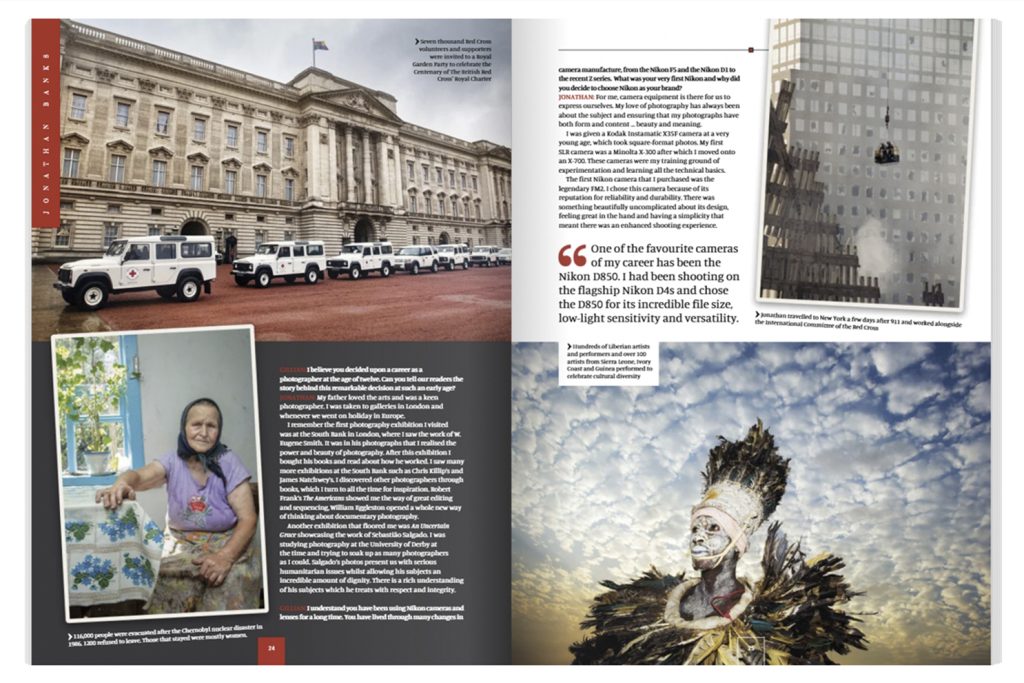
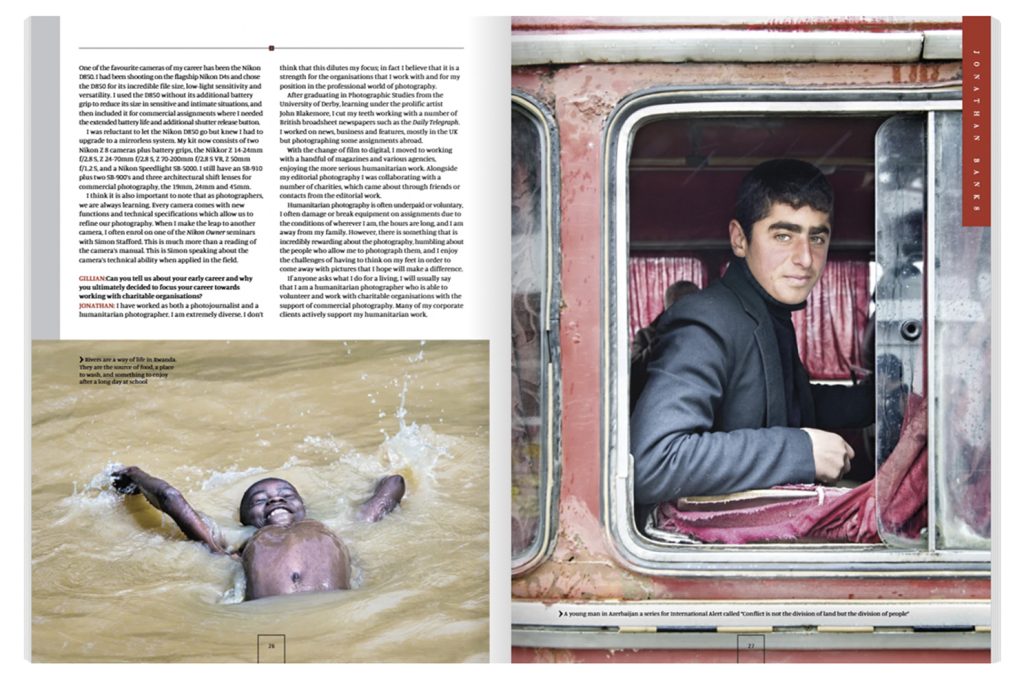
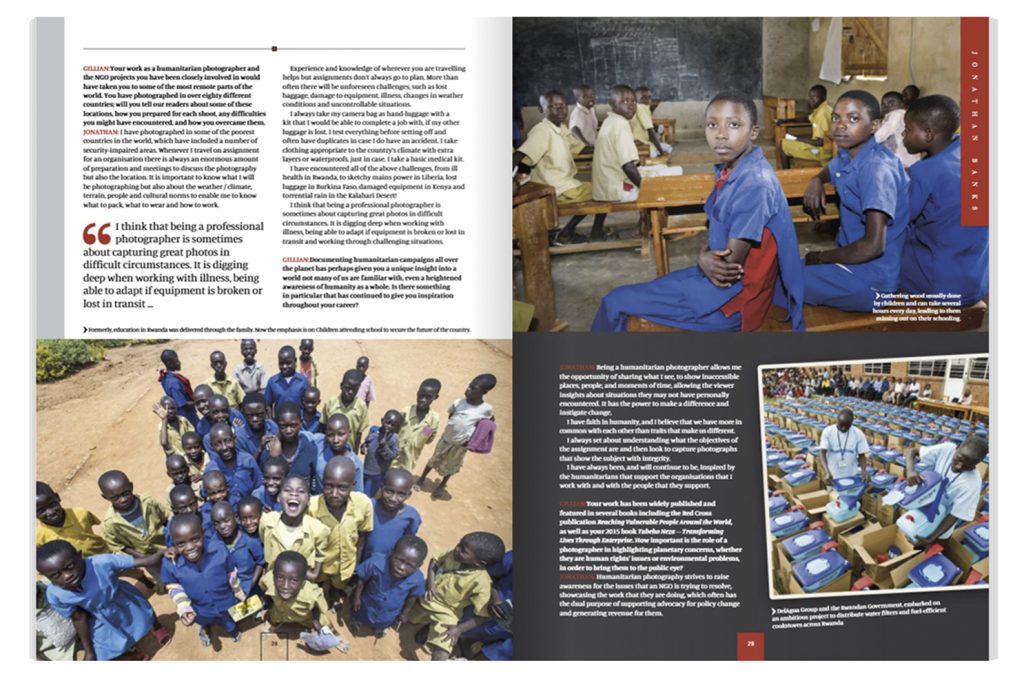
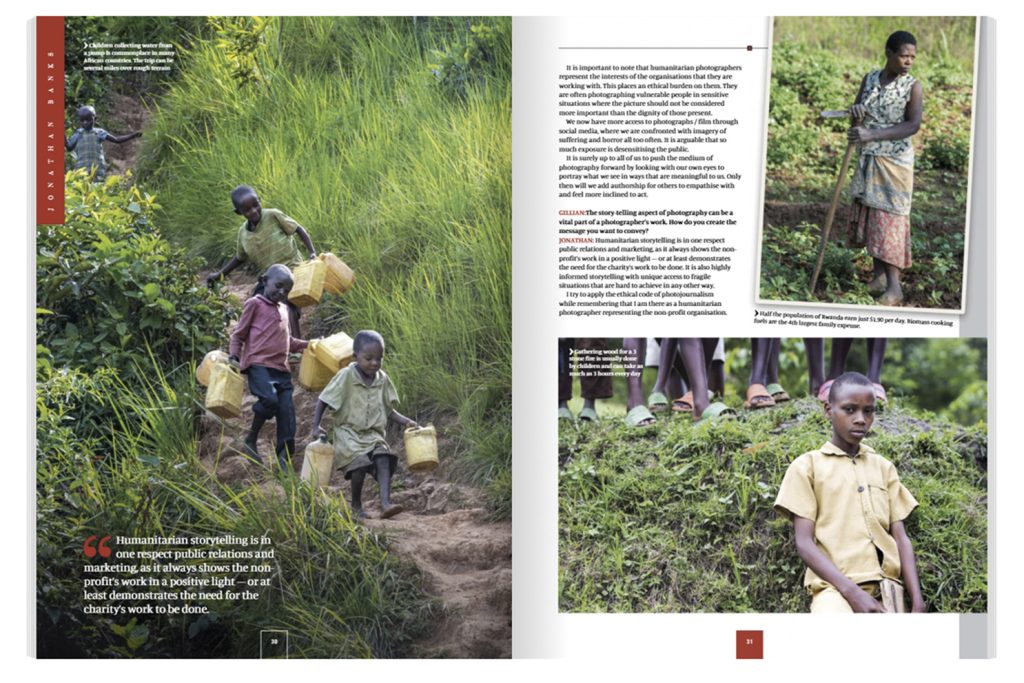
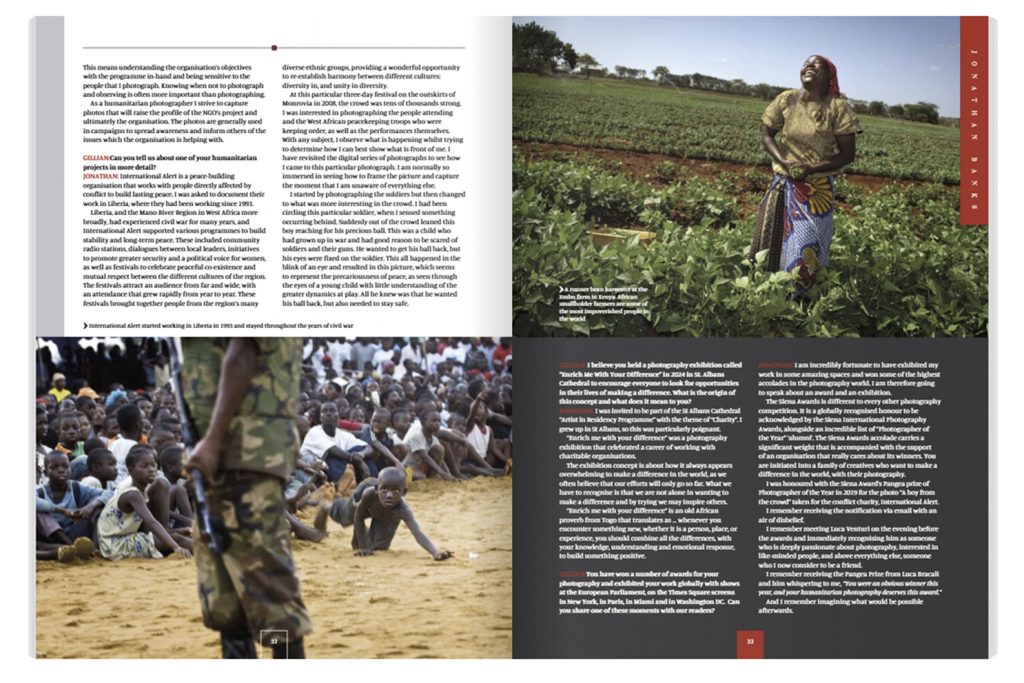
Humanitarian photography has a long, interesting history, having originally evolved during the nineteenth century from a variety of religious and anti-slavery organisations. Some of the first humanitarian images ever documented, including those of the Indian famine in the latter part of the century, were taken by colonial administrators, archivists or Christian missionaries in order to raise funds. By the 1890s, with the introduction of the first hand-held Kodak camera, patented in 1888 by George Eastman, humanitarian photography visibly expanded its sphere. A few decades later, organisations such as the newly[1]formed British Red Cross made use of photography to highlight the relief efforts badly needed during and after World War I.
The genre has developed significantly since those early days. Sometimes working with NGOs, sometimes alone, humanitarian photographers traditionally use their work to bring attention to a wide range of global difficulties – from the effects of famine and drought on a population to the bleak outcome of a long, drawn-out conflict. But the contemporary focus is not only about chronicling humanity’s problems. By documenting individual tales of courage and hope, photographers have clarified their message and given it a greater vision. The images they have created have connected viewers emotionally to the subject at hand and encouraged both empathy and support. Humanitarian photographers have raised public awareness of concerns that are vital to mankind’s survival and increased the sense of global responsibility in each of us.
Jonathan Banks is an award-winning British photographer with over twenty-five years’ experience in humanitarian photography. He works with charitable organisations and NGOs documenting important campaigns connected with human rights’ matters. He has photographed a wide range of subjects in challenging situations in over eighty different countries. Jonathan has exhibited his photography in the European Parliament, on the screens at Times Square in New York, as part of the Exposure Awards at the Louvre in Paris, at the “Beauty of Humanity” Art Basel festival in Miami and as a solo exhibition at the Phillips Collection in Washington DC. These exhibitions have been in support of organisations such as International Alert and TASSC International.
Jonathan has been the recipient of a number of awards for his photography, including FOTO8, Humanity Photo Awards, Sony World Photography Awards, and winner of international photographer of the year at the prestigious Siena International Photography Awards in 2019. His images have also been featured in several books including the Red Cross landmark publication Reaching Vulnerable People Around the World. His photography of the health programme in Rwanda was published in the 2015 book Tubeho Neza – Transforming Lives Through Enterprise. His work has been described as “responsible documentary photography that lacks the predatory or voyeuristic perspective that often plagues the genre.”
Jonathan has been a subscriber to Nikon Owner magazine for the past fifteen years; he tells our readers about some of the highlights of his career.
GILLIAN: I believe you decided upon a career as a photographer at the age of twelve. Can you tell our readers the story behind this remarkable decision at such an early age?
JONATHAN: My father loved the arts and was a keen photographer. I was taken to galleries in London and whenever we went on holiday in Europe.
I remember the first photography exhibition I visited was at the South Bank in London, where I saw the work of W. Eugene Smith. It was in his photographs that I realised the power and beauty of photography. After this exhibition I bought his books and read about how he worked. I saw many more exhibitions at the South Bank such as Chris Killip’s and James Natchwey’s. I discovered other photographers through books, which I turn to all the time for inspiration. Robert Frank’s The Americans showed me the way of great editing and sequencing, William Eggleston opened a whole new way of thinking about documentary photography.
Another exhibition that floored me was An Uncertain Grace showcasing the work of Sebastião Salgado. I was studying photography at the University of Derby at the time and trying to soak up as many photographers as I could. Salgado’s photos present us with serious humanitarian issues whilst allowing his subjects an incredible amount of dignity. There is a rich understanding of his subjects which he treats with respect and integrity.
GILLIAN: I understand you have been using Nikon cameras and lenses for a long time. You have lived through many changes in camera manufacture, from the Nikon F5 the Nikon D1 in 1999 to the recent Z series. What was your very first Nikon and why did you decide to choose Nikon as your brand?
JONATHAN: For me, camera equipment is there for us to express ourselves. My love of photography has always been about the subject and ensuring that my photographs have both form and content … beauty and meaning.
I was given a Kodak Instamatic X35F camera at a very young age, which took square-format photos. My first SLR camera was a Minolta X-300 after which I moved onto an X-700. These cameras were my training ground of experimentation and learning all the technical basics.
The first Nikon camera that I purchased was the legendary FM2. I chose this camera because of its reputation for reliability and durability. There was something beautifully uncomplicated about its design, feeling great in the hand and having a simplicity that meant there was an enhanced shooting experience. One of the favourite cameras of my career has been the Nikon D850. I had been shooting on the flagship Nikon D4s and chose the D850 for its incredible file size, low-light sensitivity and versatility. I used the D850 without its additional battery grip to reduce its size in sensitive and intimate situations and then included it for commercial assignments where I needed the extended battery life and additional shutter release button.
I was reluctant to let the Nikon D850 go but knew I had to upgrade to a mirrorless system. My kit now consists of two Nikon Z 8 cameras plus battery grips, the Nikkor Z 14-24mm f/2.8 S, Z 24-70mm f/2.8 S, Z 70-200mm f/2.8 S VR, Z 50mm f/1.2 S, and a Nikon Speedlight SB-5000. I still have an SB-910 plus two SB-900’s and three architectural shift lenses for commercial photography, the 19mm, 24mm and 45mm.
I think it is also important to note that as photographers, we are always learning. Every camera comes with new functions and technical specifications which allow us to refine our photography. When I make the leap to another camera, I often enrol on one of the Nikon Owner seminars with Simon Stafford. This is much more than a reading of the camera’s manual. This is Simon speaking about the camera’s technical ability when applied in the field.
GILLIAN: Can you tell us about your early career and why you ultimately decided to focus your career towards working with charitable organisations?
JONATHAN: I have worked as both a photojournalist and a humanitarian photographer. I am extremely diverse. I don’t think that this dilutes my focus; in fact I believe that it is a strength for the organisations that I work with and for my position in the professional world of photography.
After graduating in Photographic Studies from the University of Derby, learning under the prolific artist John Blakemore, I cut my teeth working with a number of British broadsheet newspapers such as the Daily Telegraph. I worked on news, business and features, mostly in the UK but photographing some assignments abroad.
With the change of film to digital, I moved to working with a handful of magazines and various agencies, enjoying the more serious humanitarian work. Alongside my editorial photography I was collaborating with a number of charities, which came about through friends or contacts from the editorial work.
Humanitarian photography is often underpaid or voluntary, I often damage or break equipment on assignments due to the conditions of wherever I am, the hours are long, and I am away from my family. However, there is something that is incredibly rewarding about the photography, humbling about the people who allow me to photograph them, and I enjoy the challenges of having to think on my feet in order to come away with pictures that I hope will make a difference.
If anyone asks what I do for a living, I will usually say that I am a humanitarian photographer who is able to volunteer and work with charitable organisations with the support of commercial photography. Many of my corporate clients actively support my humanitarian work.
GILLIAN: Your work as a humanitarian photographer and the NGO projects you have been closely involved in would have taken you to some of the most remote parts of the world. You have photographed in over eighty different countries; will you tell our readers about some of these locations, how you prepared for each shoot, any difficulties you might have encountered, and how you overcame them.
JONATHAN: I have photographed in some of the poorest countries in the world, which have included a number of security-impaired areas. Whenever I travel on assignment for an organisation there is always an enormous amount of preparation and meetings to discuss the photography but also the location. It is important to know what I will be photographing but also about the weather / climate, terrain, people and cultural norms to enable me to know what to pack, what to wear and how to work.
Experience and knowledge of wherever you are travelling helps but assignments don’t always go to plan. More than often, there will be unforeseen challenges, such as lost baggage, damage to equipment, illness, changes in weather conditions and uncontrollable situations.
I always take my camera bag as hand-luggage with a kit that I would be able to complete a job with, if my other luggage is lost. I test everything before setting off and often have duplicates in case I do have an accident. I take clothing appropriate to the country’s climate with extra layers or waterproofs, just in case. I take a basic medical kit.
I have encountered all of the above challenges, from ill health in Rwanda, to sketchy mains power in Liberia, lost luggage in Burkina Faso, damaged equipment in Kenya and torrential rain in the Kalahari Desert!
I think that being a professional photographer is sometimes about capturing great photos in difficult circumstances. It is digging deep when working with illness, being able to adapt if equipment is broken or lost in transit and working through challenging situations.
GILLIAN: Documenting humanitarian campaigns all over the planet has perhaps given you a unique insight into a world not many of us are familiar with, even a heightened awareness of humanity as a whole. Is there something in particular that has continued to give you inspiration throughout your career?
JONATHAN: Being a humanitarian photographer allows me the opportunity of sharing what I see, to show inaccessible places, people, and moments of time, allowing the viewer insights about situations they may not have personally encountered. It has the power to make a difference and instigate change.
I have faith in humanity, and I believe that we have more in common with each other than traits that make us different.
I always set about understanding what the objectives of the assignment are and then look to capture photographs that show the subject with integrity.
I have always been, and will continue to be, inspired by the humanitarians that support the organisations that I work with and with the people that they support.
GILLIAN: Your work has been widely published and featured in several books including the Red Cross publication Reaching Vulnerable People Around the World, as well as your 2015 book Tubeho Neza – Transforming Lives Through Enterprise. How important is the role of a photographer in highlighting planetary concerns, whether they are human rights’ issues or environmental problems, in order to bring them to the public eye?
JONATHAN: Humanitarian photography strives to raise awareness for the issues that an NGO is trying to resolve, showcasing the work that they are doing, which often has the dual purpose of supporting advocacy for policy change and generating revenue for them.
It is important to note that humanitarian photographers represent the interests of the organisations that they are working with. This places an ethical burden on them. They are often photographing vulnerable people in sensitive situations where the picture should not be considered more important than the dignity of those present.
We now have more access to photographs / film through social media, where we are confronted with imagery of suffering and horror all too often. It is arguable that so much exposure is desensitising the public.
It is surely up to all of us to push the medium of photography forward by looking with our own eyes to portray what we see in ways that are meaningful to us. Only then will we add authorship for others to empathise with and feel more inclined to act.
GILLIAN: The story-telling aspect of photography can be a vital part of a photographer’s work. How do you create the message you want to convey?
JONATHAN: Humanitarian storytelling is in one respect public relations and marketing, as it always shows the non[1]profit’s work in a positive light – or at least demonstrates the need for the charity’s work to be done. It is also highly informed storytelling with unique access to fragile situations that are hard to achieve in any other way.
I try to apply the ethical code of photojournalism while remembering that I am there as a humanitarian photographer representing the non-profit organisation. This means understanding the organisation’s objectives with the programme in-hand and being sensitive to the people that I photograph. Knowing when not to photograph and observing is often more important than photographing.
As a humanitarian photographer I strive to capture photos that will raise the profile of the NGO’s project and ultimately the organisation. The photos are generally used in campaigns to spread awareness and inform others of the issues which the organisation is helping with.
GILLIAN: Can you tell us about one of your humanitarian projects in more detail?
JONATHAN: International Alert is a peace-building organisation that works with people directly affected by conflict to build lasting peace. I was asked to document their work in Liberia, where they had been working since 1993.
Liberia, and the Mano River Region in West Africa more broadly, had experienced civil war for many years, and International Alert supported various programmes to build stability and long-term peace. These included community radio stations, dialogues between local leaders, initiatives to promote greater security and a political voice for women, as well as festivals to celebrate peaceful co-existence and mutual respect between the different cultures of the region. The festivals attract an audience from far and wide, with an attendance that grew rapidly from year to year. These festivals brought together people from the region’s many diverse ethnic groups, providing a wonderful opportunity to re-establish harmony between different cultures: diversity in, and unity in diversity.
At this particular three-day festival on the outskirts of Monrovia in 2008, the crowd was tens of thousands strong. I was interested in photographing the people attending and the West African peacekeeping troops who were keeping order, as well as the performances themselves. With any subject, I observe what is happening whilst trying to determine how I can best show what is front of me. I have revisited the digital series of photographs to see how I came to this particular photograph. I am normally so immersed in seeing how to frame the picture and capture the moment that I am unaware of everything else.
I started by photographing the soldiers but then changed to what was more interesting in the crowd. I had been circling this particular soldier, when I sensed something occurring behind. Suddenly out of the crowd leaned this boy reaching for his precious ball. This was a child who had grown up in war and had good reason to be scared of soldiers and their guns. He wanted to get his ball back, but his eyes were fixed on the soldier. This all happened in the blink of an eye and resulted in this picture, which seems to represent the precariousness of peace, as seen through the eyes of a young child with little understanding of the greater dynamics at play. All he knew was that he wanted his ball back but also needed to stay safe.
GILLIAN: I believe you held a photography exhibition called “Enrich Me With Your Difference” in St Albans Cathedral in 2024 to encourage everyone to look for opportunities in their lives of making a difference. What is the origin of this concept and what does it mean to you?
JONATHAN: I was invited to be part of the St Albans Cathedral “Artist in Residency Programme” with the theme of “Charity”. I grew up in St Albans, so this was particularly poignant.
“Enrich me with your difference” was a photography exhibition that celebrated a career of working with charitable organisations.
The exhibition concept is about how it always appears overwhelming to make a difference in the world, as we often believe that our efforts will only go so far. What we have to recognise is that we are not alone in wanting to make a difference and by trying we may inspire others.
“Enrich me with your difference” is an old African proverb from Togo that translates as … whenever you encounter something new, whether it is a person, place, or experience, you should combine all the differences, with your knowledge, understanding and emotional response, to build something positive.
GILLIAN: You have won a number of awards for your photography and exhibited your work globally with shows at the European Parliament, on the Times Square screens in New York, in Paris, in Miami and in Washington DC. Can you share one of these moments with our readers?
JONATHAN: I am incredibly fortunate to have exhibited my work in some amazing spaces and won some of the highest accolades in the photography world. I am therefore going to speak about an award and an exhibition.
The Siena Awards is different to every other photography competition. It is a globally recognised honour to be acknowledged by the Siena International Photography Awards, alongside an incredible list of “Photographer of the Year” ‘alumni’. The Siena Awards accolade carries a significant weight that is accompanied with the support of an organisation that really cares about its winners. You are initiated into a family of creatives who want to make a difference in the world, with their photography.
I was honoured with the Siena Award’s Pangea prize of Photographer of the Year in 2019 for the photo “A boy from the crowd” taken for the conflict charity, International Alert.
I remember receiving the notification via email with an air of disbelief. I remember meeting Luca Venturi on the evening before the awards and immediately recognising him as someone who is deeply passionate about photography, interested in like-minded people, and above everything else, someone who I now consider to be a friend.
I remember receiving the Pangea Prize from Luca Bracali and him whispering to me, “You were an obvious winner this year, and your humanitarian photography deserves this award.”
And I remember imagining what would be possible afterwards.
Photography is a challenging and often solitary career. You really have to love what you do, and why you are doing it. After winning the Siena Awards Pangea Prize it allowed me to reflect on my career and who I had become as a photographer. I am a humanitarian photographer who works alongside charitable organisations.
Being the Photographer of the Year at the Siena Awards is not about the achievement of winning one of the biggest awards in the industry, it is about being recognised for your creative approach in the work you are doing and using that recognition as a voice for things that matter. The Siena Awards afforded me new opportunities to further my career in the direction that I wanted. It gave me an added confidence that I was creating work that could make a difference. Most important of all the Siena Awards is a family of photographers who have the same aspirations of pushing forward the creative boundaries of photography and inspiring others to show the world what they see.
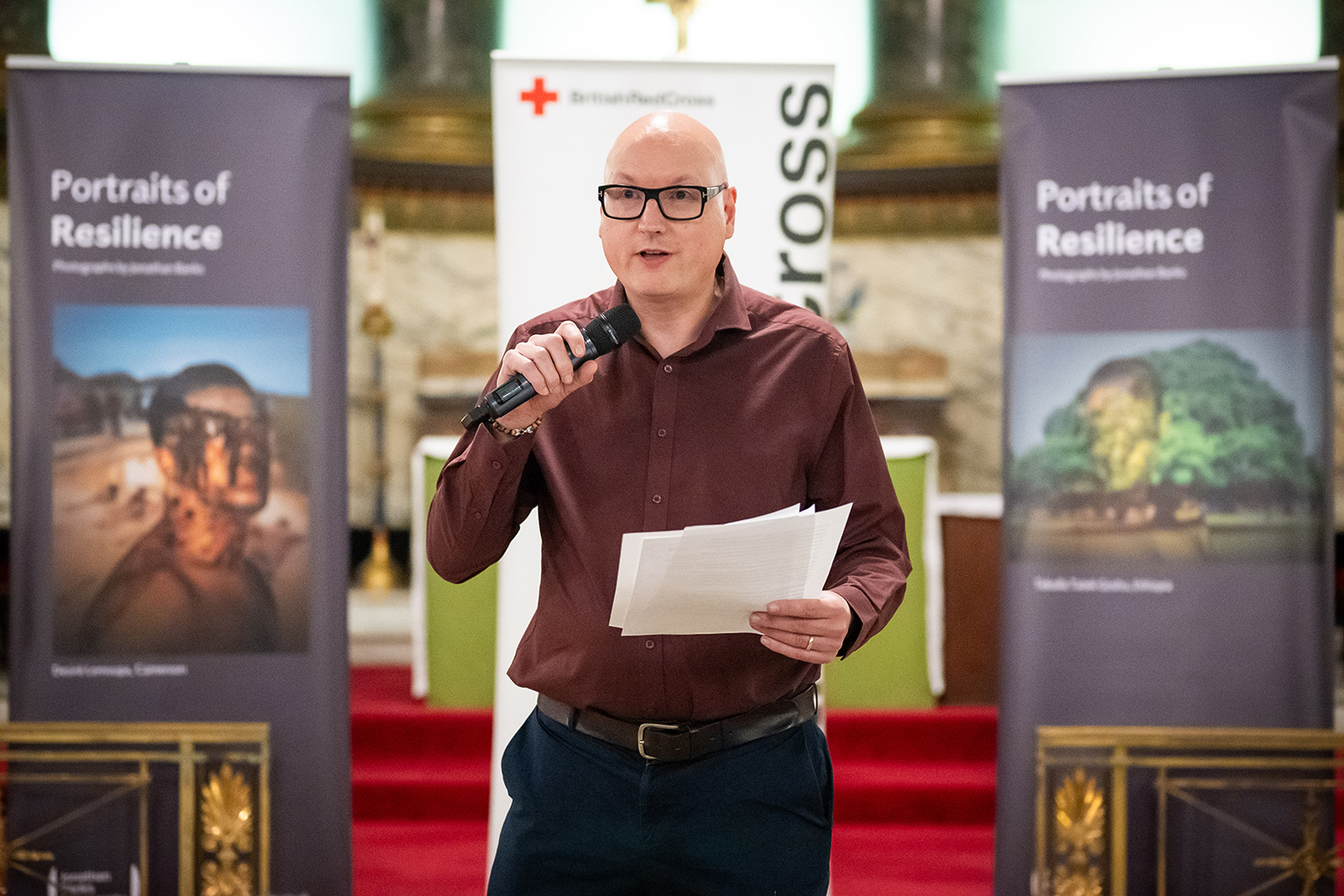
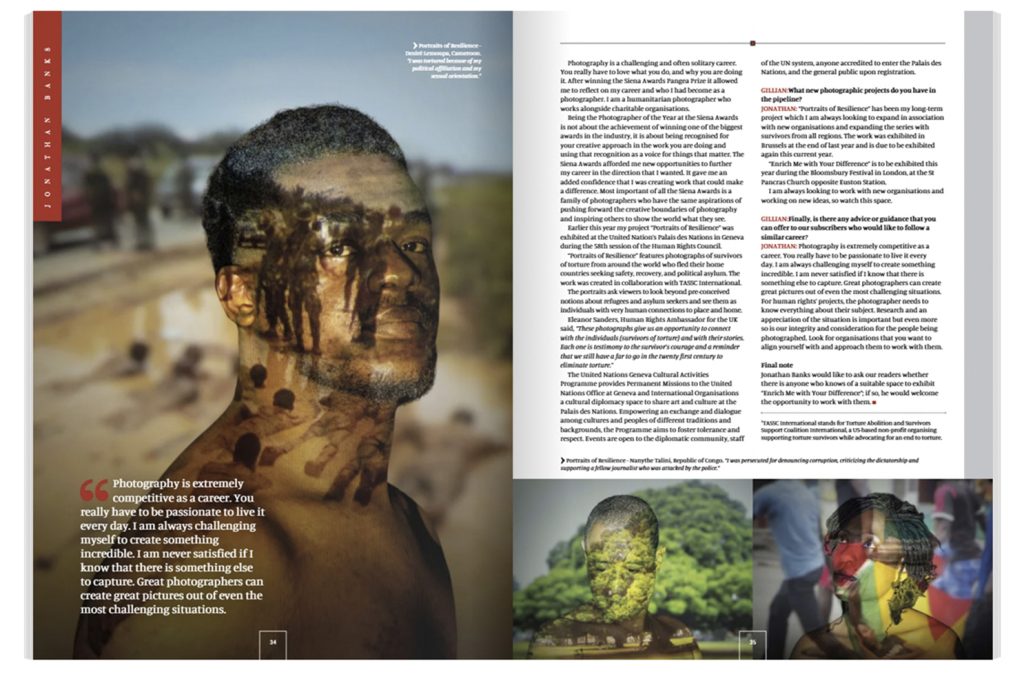
Earlier this year my project “Portraits of Resilience” was exhibited at the United Nation’s Palais des Nations in Geneva during the 58th session of the Human Rights Council.
“Portraits of Resilience” features photographs of survivors of torture from around the world who fled their home countries seeking safety, recovery, and political asylum. The work was created in collaboration with TASSC International.
The portraits ask viewers to look beyond pre-conceived notions about refugees and asylum seekers and see them as individuals with very human connections to place and home.
Eleanor Sanders, Human Rights Ambassador for the UK said, “These photographs give us an opportunity to connect with the individuals (survivors of torture) and with their stories. Each one is testimony to the survivor’s courage and a reminder that we still have a far to go in the twenty first century to eliminate torture.”
The United Nations Geneva Cultural Activities Programme provides Permanent Missions to the United Nations Office at Geneva and International Organisations a cultural diplomacy space to share art and culture at the Palais des Nations. Empowering an exchange and dialogue among cultures and peoples of different traditions and backgrounds, the Programme aims to foster tolerance and respect. Events are open to the diplomatic community, staff of the UN system, anyone accredited to enter the Palais des Nations, and the general public upon registration.
GILLIAN: What new photographic projects do you have in the pipeline?
JONATHAN: “Portraits of Resilience” has been my long-term project which I am always looking to expand in association with new organisations and expanding the series with survivors from all regions. The work was exhibited in Brussels at the end of last year and is due to be exhibited again this current year.
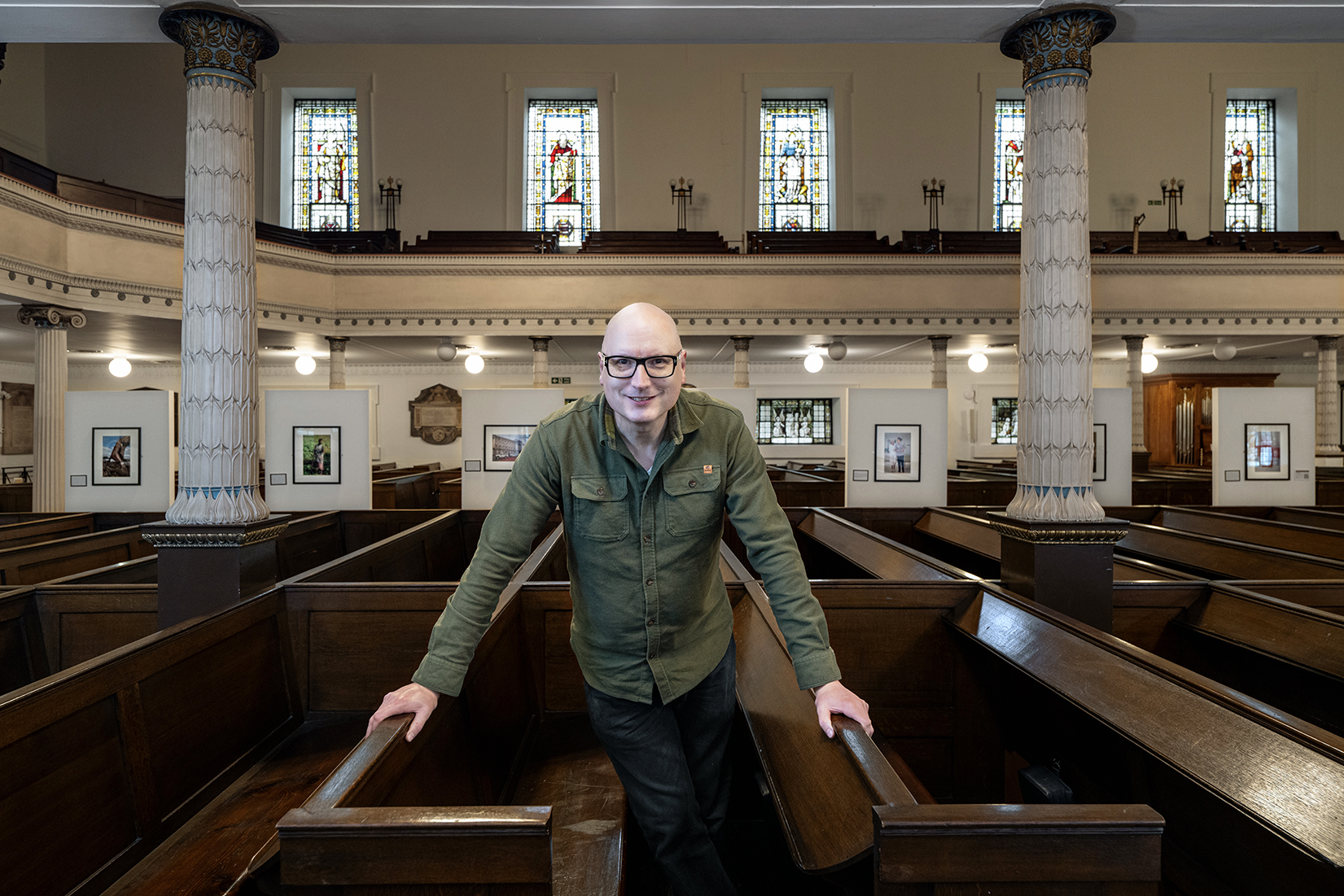
“Enrich Me with Your Difference” is to be exhibited this year during the Bloomsbury Festival in London, at the St Pancras Church opposite Euston Station.
I am always looking to work with new organisations and working on new ideas, so watch this space.
GILLIAN: Finally, is there any advice or guidance that you can offer to our subscribers who would like to follow a similar career?
JONATHAN: Photography is extremely competitive as a career. You really have to be passionate to live it every day. I am always challenging myself to create something incredible. I am never satisfied if I know that there is something else to capture. Great photographers can create great pictures out of even the most challenging situations. For human rights’ projects, the photographer needs to know everything about their subject. Research and an appreciation of the situation is important but even more so is our integrity and consideration for the people being photographed. Look for organisations that you want to align yourself with and approach them to work with them.
Final note
Jonathan Banks would like to ask our readers whether there is anyone who knows of a suitable space to exhibit “Enrich Me with Your Difference”; if so, he would welcome the opportunity to work with them.